AI Use Cases in Ecommerce: 7 Ways to Sell More (With Real Brand Examples)
You know AI can help your store. The harder question is where to start — and whether what the big brands are doing is actually relevant to a merchant at your scale.
To frame the stakes: the AI in ecommerce market was valued at $9.01 billion in 2025 and is projected to exceed $64 billion by 2034. That growth isn’t happening in boardrooms — it’s the result of specific implementation decisions happening right now, inside stores your customers also shop at.
This guide breaks down the most effective AI use cases in ecommerce, from customer experience to operations, with real brand examples and practical ways to implement them. Whether you’re exploring generative AI use cases in ecommerce or looking for quick wins, you’ll see what the big brands actually did, what it achieved, and which of these ideas make sense at your store’s scale.
10 Use Cases of AI in Ecommerce
AI-Powered Chat & Customer Support
Most customer support questions are the same questions, asked over and over: Where’s my order? What’s your return policy? Does this come in another size? Answering them manually is expensive, slow, and keeps your team from doing higher-value work. An AI-powered chatbot handles these conversations 24/7 — and when trained on your product catalog and customer scenarios, it goes further: it recommends, guides, and converts.
The measurable upside comes from three directions simultaneously: lower support costs, faster resolution times, and reduced cart abandonment among shoppers who get answers before leaving.
Real example: Sephra
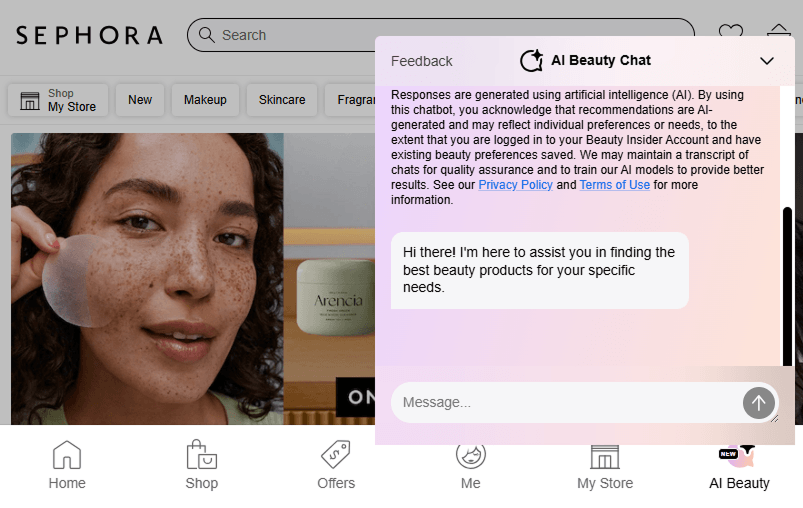
Sephora deployed an AI chatbot trained on beauty-specific data and integrated it across Facebook Messenger, their website, mobile apps, and select in-store interfaces. The bot handled product suggestions, shade matching, loyalty point queries, and order questions — asking follow-up questions and escalating to humans when genuinely needed.
75% Of daily customer inquiries resolved by Sephora’s AI chatbot — without a human agent involved.
Virtual Try-On & AR Fitting
One of the biggest friction points in online shopping is uncertainty: Will this look good on me? Will this fit? Returns are the industry’s response to that uncertainty. Virtual try-on technology attacks that problem at the source, giving shoppers confidence before they buy rather than a return label after.
Real example: ASOS
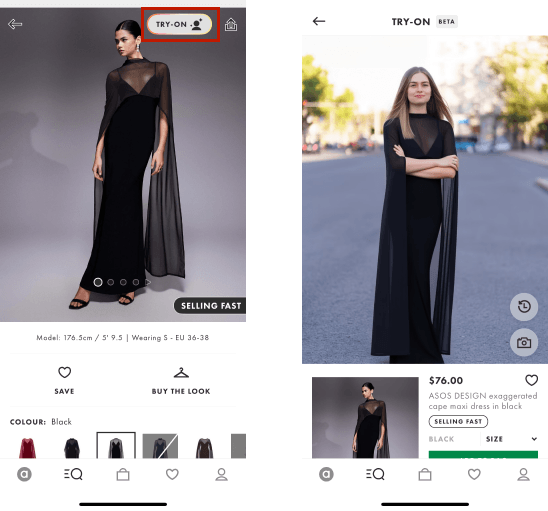
ASOS launched a virtual try-on experience allowing shoppers to view clothing on a range of body types using AI-generated models and photo-based visualization tools. Built with third-party AI try-on technology, it was rolled out across thousands of products in its mobile app to improve fit confidence and reduce purchase uncertainty. Early results indicated improved engagement and a measurable reduction in returns, particularly in categories with high sizing variability.
Real example: Sephora
Sephora’s Virtual Artist (launched in 2016) used AR and AI to let customers try on thousands of makeup products directly on their face in real time via smartphone camera. The technology tracks facial features to accurately apply products like lipstick and eyeshadow, while also supporting shade matching based on skin tone analysis and product recommendations.
AI-Powered Product Recommendations
The right recommendation at the right moment is one of the highest-leverage moves in ecommerce. Whether it’s ‘you might also like’ on a product page, ‘complete the look’ in a cart, or ‘based on what you bought’ in a post-purchase email — recommendations driven by AI consistently outperform manually curated or rule-based alternatives, because they improve as they learn.
The key distinction from basic personalization is that recommendations are product-level and purchase-proximate — they’re designed to influence the specific buying decision happening right now, not just the overall experience.
Real example: Zalando
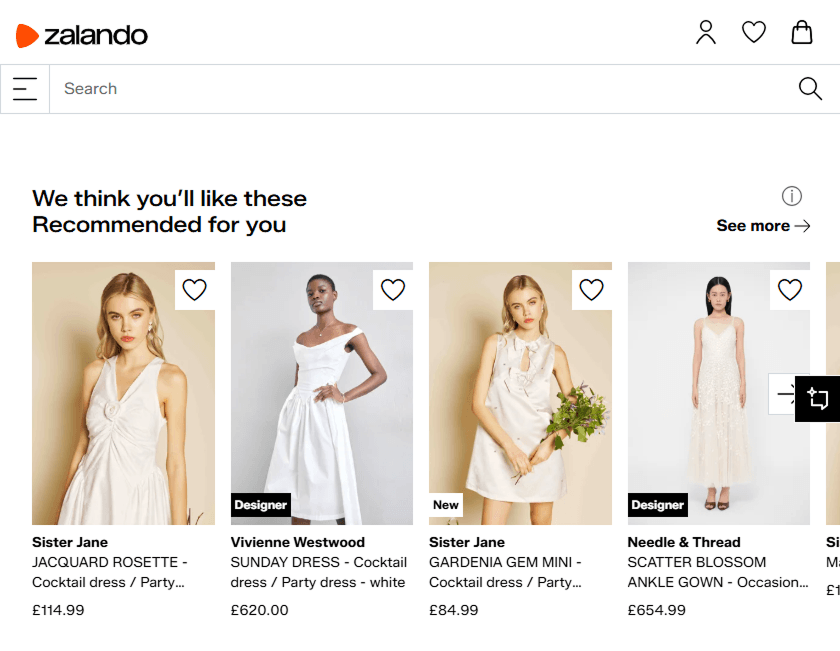
Zalando uses AI-powered recommendation systems across its platform to power features like “Recommended for you”, personalized product feeds, and size recommendations. These systems analyze browsing behavior, purchase history, and style preferences to surface relevant items in real time — both on-site and in marketing channels.
Visual & Semantic Search
A significant portion of shoppers know what they want but can’t describe it in words. They saw it on someone, in a photo, in a video — and traditional keyword search fails them completely. The visual and semantic search use case of AI in ecommerce solves this by letting shoppers search with images or by understanding the meaning behind a query rather than matching keywords literally. The result is fewer dead ends, more discovered products, and higher conversion among shoppers who were previously bouncing out of search with no results.
Real example: IKEA
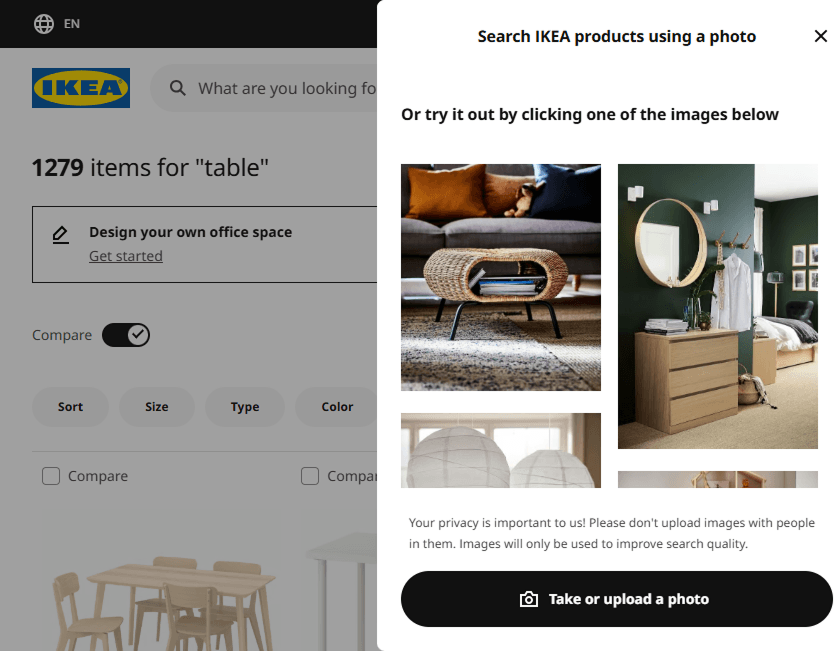
IKEA uses visual discovery tools across its digital platforms, allowing shoppers to find products from images, room setups, or real-world inspiration. Users can scan or upload photos, and AI matches shapes, colors, and styles to relevant items in its catalog.
This helps shoppers turn inspiration into purchasable products faster, reducing reliance on keywords and improving product discovery and conversion.
AI Review Summaries & Social Proof Optimization
Another powerful use case for AI in ecommerce is product summaries. Customer reviews are one of the strongest conversion drivers in ecommerce — but they only work if shoppers can extract the relevant signal from them quickly. A product with 800 reviews is almost as unhelpful as one with none if the shopper has to scroll through all of them to find out whether it runs small, whether the color looks accurate in photos, or whether it holds up after six months. AI review summarization solves this: it gives shoppers the key information at a glance, on the product page, without requiring any effort.
Real example: Amazon
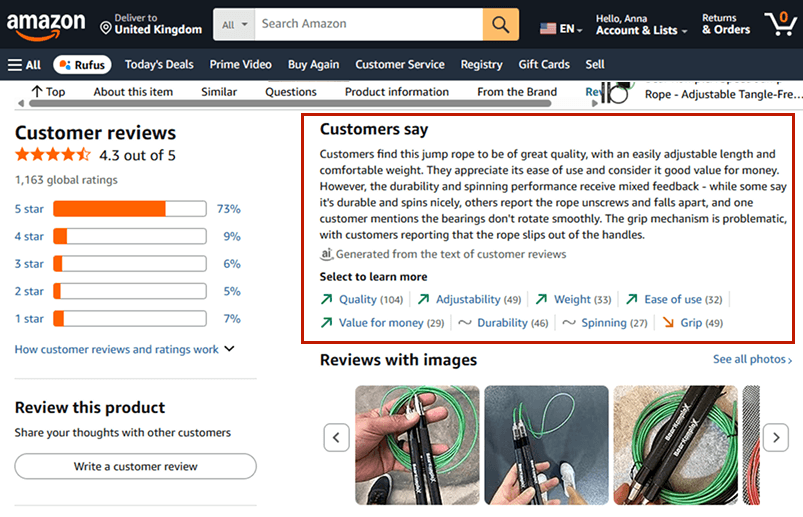
Amazon deployed a generative AI feature that places a short paragraph directly on the product detail page, distilling the most frequently mentioned features and customer sentiments from written reviews. The feature draws only from verified purchase reviews, preserving trust.

Add AI Review Summaries to Your Magento Store
Pros, cons, and sentiment from every review, on the product page.
Demand Forecasting & Inventory Planning
Overstock and stockouts are two sides of the same expensive problem. Too much inventory ties up capital and forces markdowns. Too little means lost sales and disappointed customers. Traditional forecasting relies on historical averages and gut feel — which works reasonably well in stable conditions, and fails in seasonal spikes, sudden trends, and supply chain disruptions.
AI-driven demand forecasting combines real-time sales data, external signals, regional patterns, and trend data to make predictions that are faster and more accurate than any spreadsheet model.
Real example: Zara
Zara uses AI-driven demand forecasting that combines real-time sales data, social media sentiment, regional trends, and store-level signals to predict what to produce, how much, and where to ship it. The model is built for speed — Zara’s core competitive advantage is getting trend-responsive products to market in days, not months. AI is what makes accurate inventory planning possible at that velocity.
The result: Inditex (Zara’s parent) consistently reports among the lowest markdown rates in fashion retail. Fewer markdowns means healthier margins — and healthier margins compound.
Dynamic Pricing
Price is one of the most powerful levers in ecommerce — and also one of the most underused. Most merchants set prices manually, review them infrequently, and react to competitors too slowly to protect their position.
Dynamic pricing uses AI to adjust prices automatically based on competitor pricing, demand signals, inventory levels, time of day, and customer behavior — maximizing revenue when demand is high and staying competitive when it drops. Done well, it protects margins without requiring constant manual monitoring.
Real example: Amazon
Amazon’s dynamic pricing engine updates product prices millions of times per day. The system adjusts based on competitor pricing, demand signals, inventory levels, and customer behavior — automatically, without manual intervention. It’s designed to maximize revenue at peak demand and maintain competitiveness during slower periods. This pricing intelligence is a core part of what allows Amazon to be both competitive on price and profitable at scale.
How to Choose Where to Start
Seven ecommerce AI use cases is both useful and overwhelming. Here’s a simple prioritization framework that cuts through it.
Find the intersection of two things: your highest-traffic page with your lowest conversion rate, and the use case in this article that most directly addresses why shoppers leave that page without buying.
- High traffic, high bounce on product pages → start with AI review summaries or virtual try-on
- High traffic, low add-to-cart → start with personalized recommendations or better search
- Good conversion, high returns → start with virtual try-on or more accurate sizing tools
- Strong traffic, weak email revenue → start with AI-personalized email flows
- Large catalog, thin content → start with AI-generated product descriptions
- High support volume, slow response times → start with an AI-powered chatbot
The retailers in this article didn’t implement AI across all fronts at once. Amazon’s review summaries launched in mobile only, to a subset of customers, in select categories. ASOS’s virtual try-on launched on 10,000 products on iOS only. Starting small isn’t a limitation — it’s the right approach. It reduces risk, makes measurement easier, and lets real-world results guide what comes next.
How to Actually Implement AI in Your Magento Store
The AI use cases in ecommerce above are proven. For most merchants, the gap isn’t understanding the value. It’s finding a practical way to get an AI capability into the store without a six-figure budget.
There are two routes, depending on the use case.
Use a ready-made extension where one exists. Review summaries are the fastest win on this list: AI Review Manager reads your approved reviews and publishes pros, cons, and sentiment on the product page. No development needed.
Build on a shared AI layer for everything else. Chat support, content generation, and custom workflows need development work, but not from scratch. AI Connector for Magento 2 connects your store to OpenAI, Anthropic, Google, and 400+ models through OpenRouter, with a REST API and PHP services your developers can build on. You can switch providers when a better or cheaper model ships, and every AI request is logged, so you can track costs and debug outputs.
Frequently Asked Questions (FAQ)
What is AI in ecommerce?
AI in ecommerce means using machine learning and language models to do work a store team used to do by hand, or couldn’t do at all. That covers answering customer questions, recommending products, summarizing reviews, forecasting demand, and adjusting prices. The goal isn’t to replace your team. It’s to take repetitive work off their plate and make the shopping experience faster for customers.
What are the most common AI use cases in ecommerce?
The AI use cases in ecommerce with the clearest track record are chatbots for customer support, product recommendations, visual and semantic search, virtual try-on, review summaries, demand forecasting, and dynamic pricing. Each one targets a specific leak: slow support, poor product discovery, sizing uncertainty, or unread reviews. This article covers all seven with real brand examples.
What are the benefits of AI in ecommerce for smaller stores?
Smaller stores get the same core benefits as big brands: fewer repetitive support tickets, faster product discovery, and product pages that answer buyer questions before they leave. The difference is scale. You don’t need Amazon’s engineering team to start. Many AI features now come as ready-made extensions you can install and configure in a day.
What is an AI review summary?
An AI review summary reads all the reviews for a product and condenses them into a short overview, usually with the main pros, cons, and overall sentiment. It sits on the product page, so shoppers get the gist without scrolling through dozens of reviews. Amazon shows these on product pages, and Magento stores can add them with AI Review Manager.
How do I add AI to my Magento store?
It depends on the use case. For review summaries and AI replies to reviews, install AI Review Manager, and no development is needed. For custom features like a chatbot or content generation, AI Connector for Magento 2 gives your developers one integration with OpenAI, Anthropic, Google, and hundreds of other models, so they build on it instead of starting from scratch.

![Ecommerce Product Badges: Examples from Top Retailers [2026]](https://plumrocket.com/blog/wp-content/webpc-passthru.php?src=https://plumrocket.com/blog/wp-content/uploads/2024/07/blog-post-ecommerce-product-badges-2.png&nocache=1)