
Magento 1 Migration Statistics: Where Stores Ended Up

Magento 1 reached end of life in June 2020, forcing merchants to choose between upgrading, switching platforms, or staying on unsupported software.
Six years later, we checked 13,080 former Magento 1 websites to see where they ended up. Today, 12.9% run Shopify, 8.3% run Magento 2 or Adobe Commerce, and 7.4% still appear to run Magento 1. Others moved to different platforms, went offline, or no longer reveal which platform they use. There was no single Magento 1 migration path.
Magento 1 Migration Statistics: Key Findings
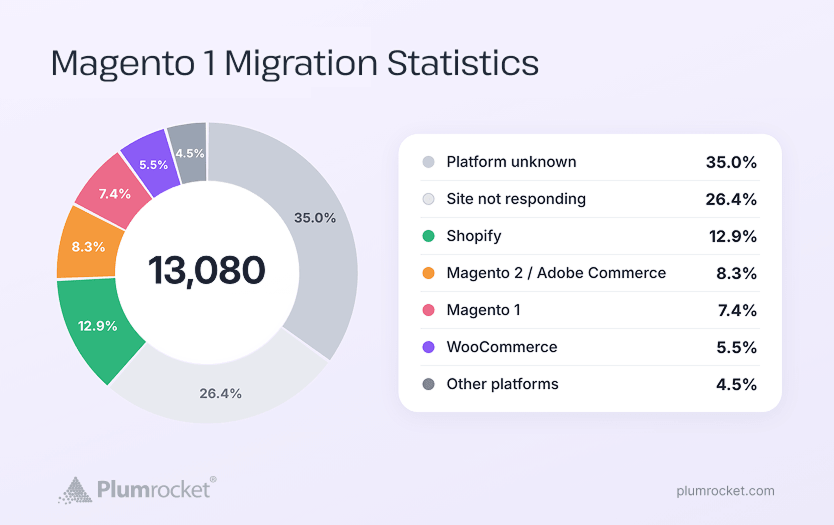
Of the 13,080 former Magento 1 websites we checked:
- Shopify is the most common platform at 12.9%, running about 1.5 times as many sites as Magento 2.
- Magento 2 and Adobe Commerce come second at 8.3%, almost all of it the free Open Source edition. Adobe Commerce is confirmed on just 34 sites.
- 7.4% still run Magento 1. Six years after support ended, that’s almost as many as run Magento 2.
- WooCommerce runs 5.5%, and another 4.5% is spread across 26 smaller platforms.
- More sites run other platforms than Magento: 22.8% run a non-Magento platform, against 15.7% on Magento 1 or 2.
- 26.4% no longer respond, and 35.0% are online with an unknown platform. Some of these businesses closed, but many moved, rebranded or run a custom platform that doesn’t show up in detection.
Since many sites don’t reveal their platform, treat each platform’s share as a minimum.
Where Magento 1 Stores Are Six Years After End of Life
For this study, we took 13,080 domains from our own records, collected between 2013 and 2026: real stores we know ran Magento 1. Then we checked what each one runs today.
These Magento 1 statistics come from a large sample, not a census of every Magento 1 store ever built, and they show where stores are now rather than every step they took since 2020. Some sites no longer respond, many now run other platforms, and a surprisingly large group still runs Magento 1. Let’s go through it step by step, starting with the biggest group.
| Current platform or status | Websites | Share of all 13,080 |
|---|---|---|
| Shopify | 1,690 | 12.9% |
| Magento 2 / Adobe Commerce | 1,092 | 8.3% |
| Magento 1 | 966 | 7.4% |
| WooCommerce | 713 | 5.5% |
| BigCommerce | 94 | 0.7% |
| PrestaShop | 78 | 0.6% |
| Shopware | 76 | 0.6% |
| Other platforms | 335 | 2.6% |
| Site not responding | 3,454 | 26.4% |
| Platform not identifiable | 4,582 | 35.0% |
| Total | 13,080 | 100% |
The 13,080 websites we checked fall into three groups. Most of them (61.4%) don’t reveal their platform:
- Site not responding (26.4%). The domain didn’t return a working page. Some of these businesses closed, while others rebranded, moved to a new domain, merged websites or were acquired. A few were simply down when we checked. So this isn’t a closure rate, even though it’s tempting to read it that way.
- Platform unknown (35.0%). The site is online but shows no signs of a known ecommerce platform. Most are custom-built stores, company sites without a shop, or domains that only show a placeholder page. A smaller part blocks automated checks with a firewall or bot protection. Larger stores use this kind of protection more often, so this group may hide some bigger merchants.
- Platform confirmed (38.6%). The site runs a recognizable ecommerce platform: 5,044 sites in total. This is where merchants’ real choices become visible, and it’s the group we look at in detail below.
Service
Shopify leads our data. Does it fit your store?
We build on Magento, Shopify, Wix and Squarespace, so we’ll compare them against your catalog, custom features and integrations, not a feature checklist.
Which Platforms Former Magento 1 Stores Use Today
To compare platforms fairly, from here on we take the 5,044 sites with an identified platform as 100%. That’s why the shares below are higher than the ones above.
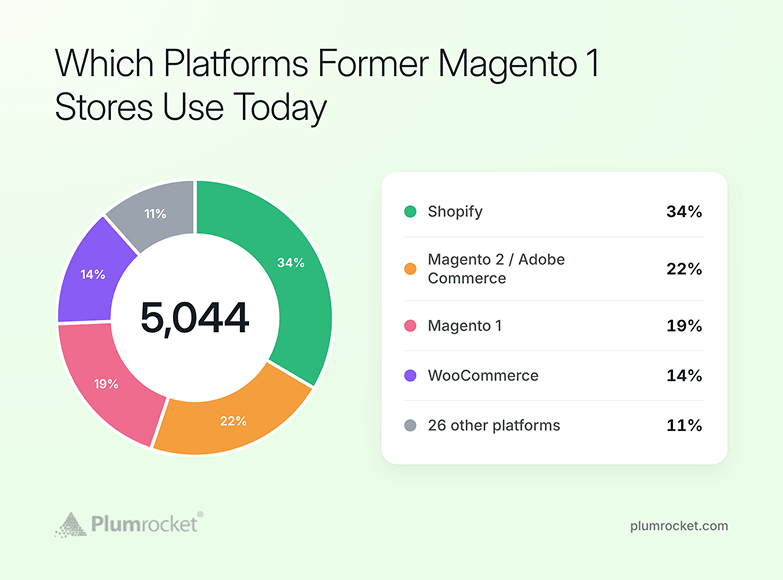
| Current platform | Share of 5,044 identified |
|---|---|
| Shopify | 34% |
| Magento 2 / Adobe Commerce | 22% |
| Magento 1 | 19% |
| WooCommerce | 14% |
| BigCommerce | 2% |
| PrestaShop | 1% |
| Shopware | 1% |
| 23 other platforms | 7% |
Keep in mind that this shows where each site is now, not the route it took to get there. A store on Shopify today may have moved to Magento 2 first and switched later.
Shopify Leads Magento 2 by 1.5×
Shopify runs 34% of identified sites, about 1.5 times as many as Magento 2 and Adobe Commerce combined. Among the 4,078 identified sites that have left Magento 1, its share climbs to 41%.
That’s striking, because Magento 2 was the official successor, and yet most of these sites don’t run it today. We see this often with merchants: when a store has to be rebuilt anyway, many decide they’d rather not run their own hosting, patches and updates again. It’s much more convenient for them to move to Shopify, which handles most of that for them.
Still, popular doesn’t mean right for every store. Shopify trades control for convenience, and stores with heavy custom logic, complex B2B pricing or unusual integrations often discover its limits after the move rather than before. If you’re weighing it, our Magento 1 to Shopify migration page explains what the move involves.
Magento 2 Is the Second Most Common Platform
Magento 2 and Adobe Commerce run 22% of sites. Nearly all of them use the free Magento Open Source edition; the paid Adobe Commerce is confirmed on just 34 sites.
That’s a solid group, and it makes sense. Magento 2 is still a strong fit for stores that need complex catalogs, custom checkout logic, deep integrations, advanced B2B features or full control over their code.
So the real question isn’t whether Magento 2 lost to Shopify, but whether Magento’s flexibility still pays off for your business. If it does, keep the platform current and treat Magento upgrades as routine maintenance. Putting them off is exactly how many Magento 1 stores ended up stuck.
Magento 1 Still Powers 19% of Sites
This was the finding that surprised us most: 966 sites, or 19% of detected sites, still appear to run Magento 1, almost as many as run Magento 2. For these stores, a Magento 1 to Magento 2 migration or a move to another platform is still ahead.
Adobe ended official support for Magento Commerce 1 and Magento Open Source 1 in June 2020, and the patches released that month were the last official security updates. Since then, every store on Magento 1 has had to handle security fixes, PHP compatibility, payment integrations and its other dependencies on its own.
That risk became very concrete in October 2026, when PHP disclosed PHP2Shell (CVE-2026-109618 and CVE-2026-109619), two critical flaws that let an attacker run code on a server with a single crafted request. PHP fixed them only in versions 8.2 to 8.5. The original Magento 1 was built for much older PHP versions that get no official fix, so many of these stores can’t simply install the patch.
Some of these stores may run OpenMage LTS, a community-maintained fork of Magento 1, or rely on third-party security patches. The study doesn’t separate those cases or assess the security of individual sites. What it does show is that a large group of stores is still online on the old codebase.
Service
Still on Magento 1? Plan your move now
We migrate stores from Magento 1 to Magento 2, Shopify and other platforms. See what the move involves for a store like yours.
WooCommerce Ranks Fourth Among Former Magento 1 Sites
WooCommerce runs 14%, about two-thirds as many as Magento 2. That makes it the fourth most common platform in our data, and the second outside the Magento family after Shopify.
It’s easy to see the appeal. WooCommerce is a free plugin for WordPress, so stores keep full control of their site at a lower cost, and content-heavy brands already on WordPress get their store and blog in one place. The trade-off is that, like Magento, it’s self-hosted: hosting, security and plugin updates are still your job.
Beyond the Big Four: 26 Other Ecommerce Platforms
Beyond the four biggest platforms, the numbers drop quickly. BigCommerce, PrestaShop, and Shopware each run 1% to 2%. BigCommerce is a hosted alternative to Shopify, while PrestaShop and Shopware are open-source platforms with strong bases in France and Germany.
The remaining 7% is grouped as “23 other platforms” in our table, and none of them runs more than 60 sites in our data. They fall into three types:
- Regional platforms, such as Tiendanube and VTEX in Latin America or JTL-Shop in Germany
- Website builders like Wix, Squarespace and Webflow, typically used by smaller stores
- Open-source and niche platforms, such as OpenCart and Odoo
Taken together, non-Magento platforms run 59% of identified sites. What we didn’t see is a clear move upmarket. Only 43 sites run Salesforce Commerce Cloud, and Adobe Commerce is confirmed on just 34. Larger stores block automated checks more often, so some may sit in the “platform unknown” group.
Still, among identified sites, most that left Magento now run something simpler, not bigger.
Will Shopify Still Lead in the AI Era?
Shopify attracted more former Magento 1 stores than any other platform in our study. And it’s easy to see why: Shopify takes care of hosting, security, and much of the maintenance, making it easier and often less expensive to run an online store. But with AI changing how software is built, will Shopify remain the obvious choice for so many merchants?
AI could make Magento development faster and more affordable. In Stack Overflow’s 2025 Developer Survey, 84% of developers said they use or plan to use AI tools. Even Adobe is moving in this direction, launching its Commerce Developer Agent in September 2026 to speed up customizations and integrations. Magento still requires experienced developers, but AI could reduce the time and cost of building and maintaining custom functionality.
That could make Magento Open Source more attractive, especially for merchants who need flexibility. Unlike Shopify, which charges additional transaction fees of up to 2% when using certain third-party payment providers, Magento Open Source charges no platform transaction fees. If development becomes more affordable, merchants may have more reasons to reconsider the trade-off between Shopify’s convenience and Magento’s control.
And this shift may go beyond ecommerce. Retool’s 2026 Build vs. Buy report found that 35% of surveyed teams had already replaced at least one SaaS tool with custom-built software, while 78% planned to build more. While these findings don’t specifically cover ecommerce, they suggest that businesses are increasingly willing to reconsider subscription software as custom development becomes more accessible.
Does that mean merchants will start moving back to Magento? Not necessarily. Shopify’s convenience remains a major advantage. But the next six years could look different if AI makes the flexibility of open-source platforms more affordable.
What This Means for Your Next Platform Decision
Our study shows where former Magento 1 stores ended up, but there’s no single platform that fits every business. If you’re planning a migration or reconsidering your current setup, here’s what to take from the findings.
If You’re Still on Magento 1
Our research identified 966 websites still running Magento 1, six years after official support ended. If yours is one of them, a Magento 1 migration should be a priority.
Before deciding where to move, review what your store depends on: custom features and extensions, integrations with payment and business systems, and the customer, order and SEO data you need to preserve. These requirements will help you determine which platform can support your business without unnecessary rebuilding.
If You’re Considering Shopify
Shopify was the most popular platform among identified former Magento 1 stores in our study, accounting for 34%. As we noted above, its main appeal is convenience.
It’s a strong choice if you want a simpler setup and your requirements fit its built-in features and app ecosystem. However, consider the ongoing cost of subscriptions, apps and payment processing, along with any custom functionality you may need. Shopify offers extensive customization, but some features depend on your plan or platform APIs.
If You’re Considering Magento 2
Magento 2 accounted for 22% of identified sites in our study, making it the second most common platform. It’s particularly well suited to stores with complex catalogs, custom business logic, B2B requirements or integrations that need greater flexibility.
Magento Open Source gives you full control over your store’s code. But you’ll need to budget for hosting, security, upgrades and ongoing development. Plan these from the beginning rather than treating maintenance as an occasional task. If speed matters, consider a modern frontend such as Hyvä as part of the build.
What About Other Platforms?
WooCommerce is worth considering if your business already relies heavily on WordPress. Regional platforms such as Shopware and Tiendanube may better serve specific markets, while Wix and Squarespace can work well for smaller stores with straightforward ecommerce needs.
At Plumrocket, we develop and migrate stores on Magento, Shopify, Wix and Squarespace. The best platform isn’t necessarily the most popular one in our study, but the one that fits your requirements and long-term costs.
Frequently Asked Questions (FAQ)
How many Magento 1 stores are still running in 2026?
There’s no official global count. In our study, 966 former Magento 1 websites still appeared to run Magento 1. That’s 19% of the 5,044 sites with an identifiable platform, or 7.4% of all 13,080 websites we checked.
When was Magento 1 end of life, and is it still supported?
Magento 1 reached end of life in June 2020 and is no longer supported. Adobe’s June 2020 security bulletin confirmed that those patches were the last official security updates for Magento Commerce 1 and Magento Open Source 1. Stores still on Magento 1 get no platform security updates from Adobe, though some use community forks such as OpenMage or third-party fixes.
What platforms are former Magento 1 stores using today?
We checked 13,080 former Magento 1 websites and identified the current platform on 5,044 of them. Of those 5,044, Shopify leads at 34%, followed by Magento 2 and Adobe Commerce at 22%, Magento 1 at 19% and WooCommerce at 14%. The remaining 11% is spread across 26 platforms, led by BigCommerce, PrestaShop and Shopware.
Are Magento stores moving to Shopify?
Among former Magento 1 stores, more now run Shopify than any other platform: 1,690 sites, about 1.5 times as many as Magento 2 and Adobe Commerce combined, and 41% of the 4,078 identified sites no longer on Magento 1. Our data shows only the current platform, so it can’t confirm a direct move for each site, and it says nothing about stores that started on Magento 2.
Is Magento dying?
No, but it’s no longer the default choice it once was. Of the 5,044 former Magento 1 websites in our study with an identifiable platform, 41% still run Magento 1 or 2, while 59% now run other platforms, most often Shopify. Magento remains a strong fit for complex catalogs, deep integrations and B2B, and as AI makes custom development cheaper, that flexibility gets easier to justify. Our study covers former Magento 1 stores only, not the whole Magento market.
Should a Magento 1 store move to Magento 2 or Shopify?
It depends on your store’s requirements, not on what others chose. Among the 4,078 former Magento 1 sites in our study that are no longer on Magento 1, 41% now run Shopify and 27% Magento 2. Shopify suits stores that want a simpler setup, with hosting and maintenance handled for them. Magento 2 suits complex catalogs, custom logic, deep integrations and B2B. List your custom features, integrations and running costs, then choose the platform that covers them with the least rebuilding. Our Magento vs Shopify comparison covers the differences in detail.
Where does this data come from?
These Magento statistics come from the Plumrocket Magento 1 Migration Study, based on Plumrocket’s internal data. We took 13,080 domains from our own records, collected between 2013 and 2026, of real stores known to have run Magento 1, and checked what each one runs today. Of these, 5,044 (38.6%) run an identifiable ecommerce platform; the rest no longer respond or don’t reveal their platform.


